
An Update from MULTI-MAREX
The second year of the MULTI-MAREX mission was characterized by intensive field research as well as the targeted strengthening of the interface between science, society, and political decision-makers in the Aegean region and at the level of the Greek government.
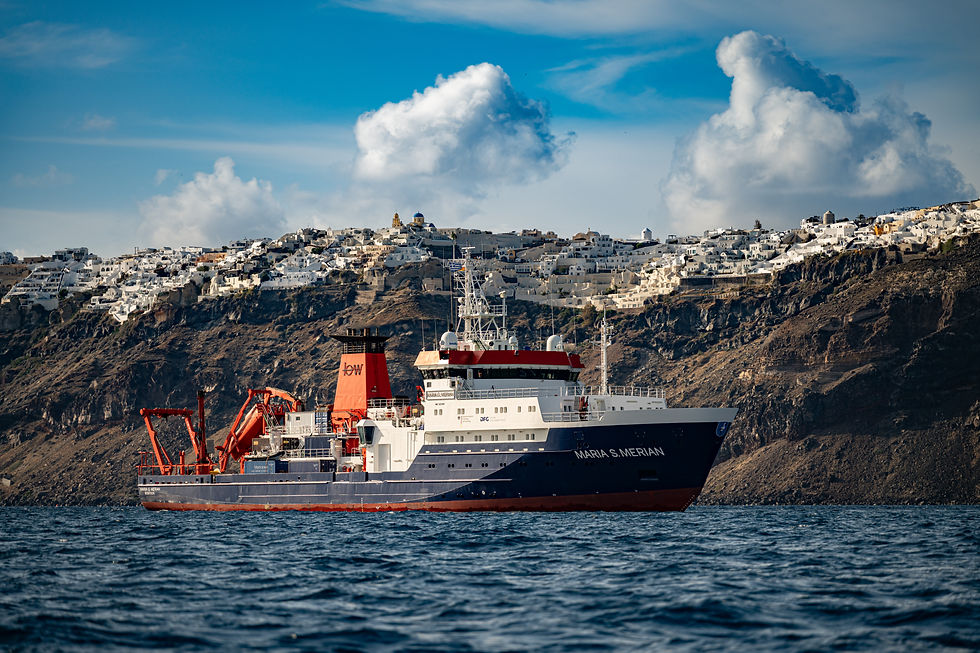
The first phase of marine research had already begun at the end of 2024. At the end of January 2025, a seismic crisis began in the sea area between Santorini and Amorgos, with more than 30,000 earthquakes recorded. On February 2, MULTI-MAREX initiated a rapid-response mission. In close cooperation with Greek partners, measuring instruments were installed on the seafloor of the Santorini caldera in order to precisely and promptly record the location, number, and magnitude of the earthquakes, as well as accompanying risks such as submarine landslides and potential tsunami hazards.
The scientific findings obtained were processed at short notice and transmitted as evidence-based situation reports to the responsible Greek authorities and to the Prime Minister, in order to provide targeted support for official hazard management during the acute crisis. MULTI-MAREX thus assumed an immediate scientific advisory role and provided robust decision-making foundations at the highest political level. At the same time, the public was comprehensively informed about the course of events.
A scientific highlight of the joint project was the publication of key findings on the seismic crisis in the Aegean in the renowned journal Nature (Isken, Karstens et al., 2025). This publication underscores the international scientific relevance of MULTI-MAREX’s work and simultaneously demonstrates how excellent research, operational crisis response, and political decision support can be effectively integrated.
The seismic crisis and the support provided to the Greek authorities illustrate the effectiveness of the MULTI-MAREX approach to improving hazard management in the Aegean and also demonstrate its transferability to other regions exposed to geomarine risks. Central to this approach was the close collaboration between scientists from Germany and Greece, local authorities, governmental institutions, and experts in media and science communication. The joint development of application-oriented knowledge and mitigation measures proved to be effective, timely, and practice-oriented, demonstrating concrete pathways for strengthening the resilience of coastal regions.
Alongside crisis management, long-term project activities were continued and expanded. These included the establishment of transdisciplinary Living Labs, among others within the framework of the UNESCO-IOC “Tsunami Ready” programme, as well as intensive coordination with local, national, and international partners to sustainably strengthen disaster preparedness. Educational and outreach activities, including school events in Greece and Germany involving several thousand students, complemented this work and contributed to strengthening societal risk awareness in Kalamata and on Santorini.


Comments